Outdoor Blinds in Singapore: How to Choose the Right System for Your Balcony
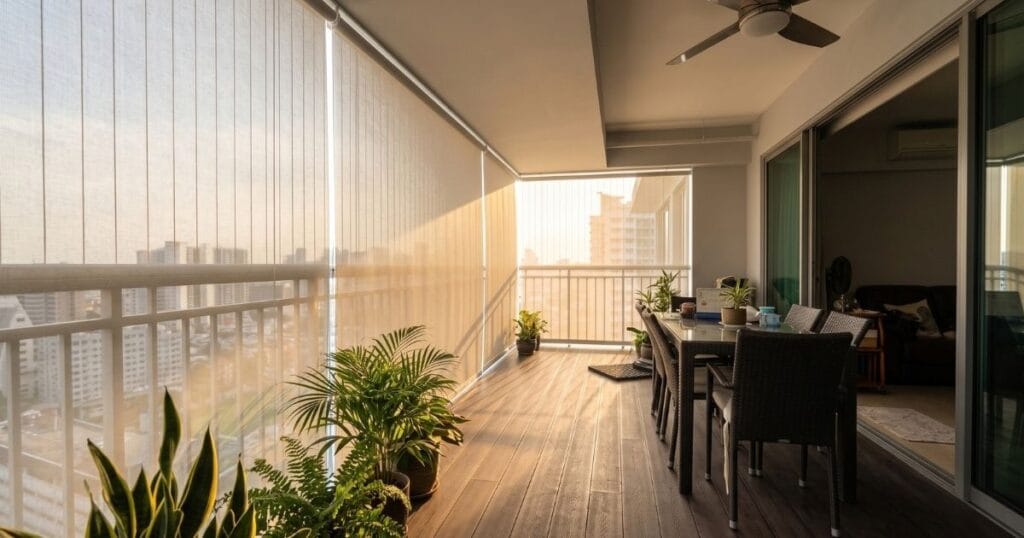
A balcony that feels comfortable in the morning can become hot and exposed by mid-afternoon. For homeowners comparing outdoor blinds Singapore options, the right system can make a balcony, patio or outdoor-facing space much more comfortable throughout the day.
Outdoor blinds can reduce harsh sunlight and glare, improve daytime privacy and provide some protection from rain splash while keeping the space connected to the outdoors. The important part is choosing a system that suits the actual exposure of your home—not simply choosing the strongest or most expensive option.
In Singapore, a sheltered condo balcony and an exposed high-floor opening can require very different solutions. This guide explains how to choose between outdoor roller blinds, motorised options and ZipScreen based on sunlight, wind exposure, privacy and everyday use.
Why Outdoor Blinds Singapore Homes Use Need the Right Fit
Singapore’s sun is not something homeowners imagine. According to Singapore’s National Environment Agency (NEA), UV levels commonly reach Very High to Extreme levels between 11am and 3pm on days with little cloud cover.
For east- and west-facing homes, low-angle sunlight can be particularly noticeable. BCA’s guidance on tropical building design also identifies east and west façades as receiving significant solar exposure and recognises external screening as one way to reduce direct solar exposure.
This is one reason an uncovered balcony can become uncomfortable surprisingly quickly.
Instead of dealing with the sunlight only after it passes through your balcony doors or windows, an external blind provides shade further outside the living space.
For everyday living, that can mean:
- less uncomfortable glare on televisions and computer screens;
- more privacy from neighbouring units;
- a shaded balcony for dining or relaxing;
- less direct sunlight reaching outdoor furniture; and
- a more usable transition between indoor and outdoor spaces.
The important part is matching the blind to the actual exposure.
Start with the problem you want to solve
Before comparing fabrics, colours or motors, stand in your balcony at the time when it is normally most uncomfortable.
What is actually bothering you?
If it is mainly afternoon glare, you may not need the most enclosed outdoor system available.
If the balcony is overlooked by another block, daytime privacy may matter more.
If strong wind and wind-driven rain regularly enter an exposed high-floor balcony, a standard cable-guided outdoor blind may not provide the level of protection you expect.
This distinction matters because EcoHaus offers both Outdoor Blinds and ZipScreen, and they are designed for different levels of exposure.
Standard outdoor blinds: simple shade for everyday balcony living
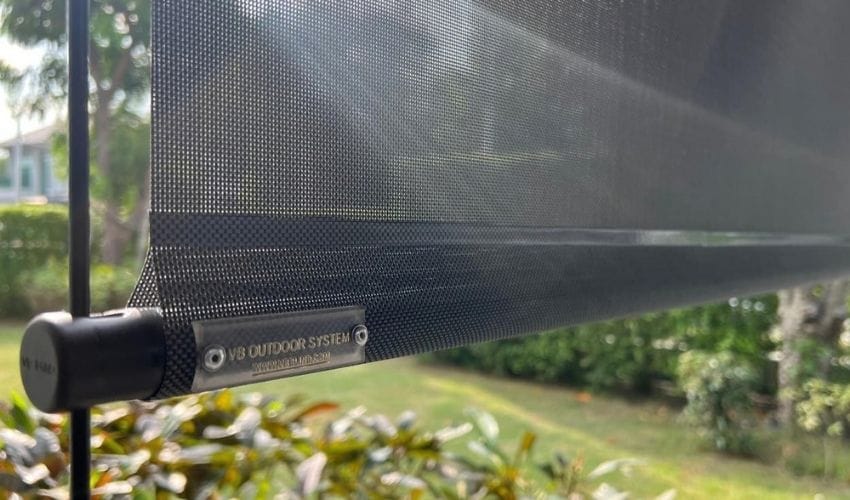
EcoHaus outdoor roller blinds use cable guides to keep the blind aligned as it moves.
They are designed primarily for sun protection, glare reduction, privacy and everyday outdoor shade, making them particularly relevant for sheltered or moderately exposed balconies, patios and outdoor spaces.
EcoHaus offers two outdoor blind configurations.
Flat Bar System
The Flat Bar System uses a weighted flat bottom bar with cable guides positioned discreetly behind the fabric.
It is particularly useful for wider balconies that require several blinds installed side by side. The arrangement helps multiple panels look cleaner and more continuous across a large opening.
Round Bar System
The Round Bar System uses a round bottom bar with side-mounted cable guides.
Its cleaner, symmetrical profile makes it particularly suitable for a single blind or a smaller opening where you want a simple outdoor shade without making the system visually dominant.
Neither choice is automatically better. The shape and number of openings should determine the configuration.
When should you consider ZipScreen instead?
A standard outdoor blind should not be mistaken for a fully enclosed weather barrier.
Because cable-guided outdoor blinds have open spaces along their sides, some wind, insects and wind-driven rain can still pass around the fabric.
For a more exposed opening, EcoHaus’s Outdoor ZipScreen uses a different construction. Its z-LOCK™ side-retention system holds the fabric inside aluminium side channels, reducing the open side gaps found in conventional cable-guided blinds.
That makes ZipScreen worth considering for spaces such as:
- exposed high-floor condo balconies;
- west-facing balconies affected by strong afternoon sun;
- landed patios with larger openings;
- outdoor dining areas affected by rain splash;
- balconies where insects are a recurring concern; and
- areas where stronger fabric stability is required.
Think of the choice this way: if your main concerns are shade, glare and privacy in a relatively sheltered area, an outdoor roller blind may be enough.
If you also need greater wind stability, smaller side gaps and stronger weather protection, look at ZipScreen.
Our detailed ZipScreen vs Outdoor Roller Blinds Singapore guide compares the two systems more closely.
What about rain?
This is an area where expectations matter.
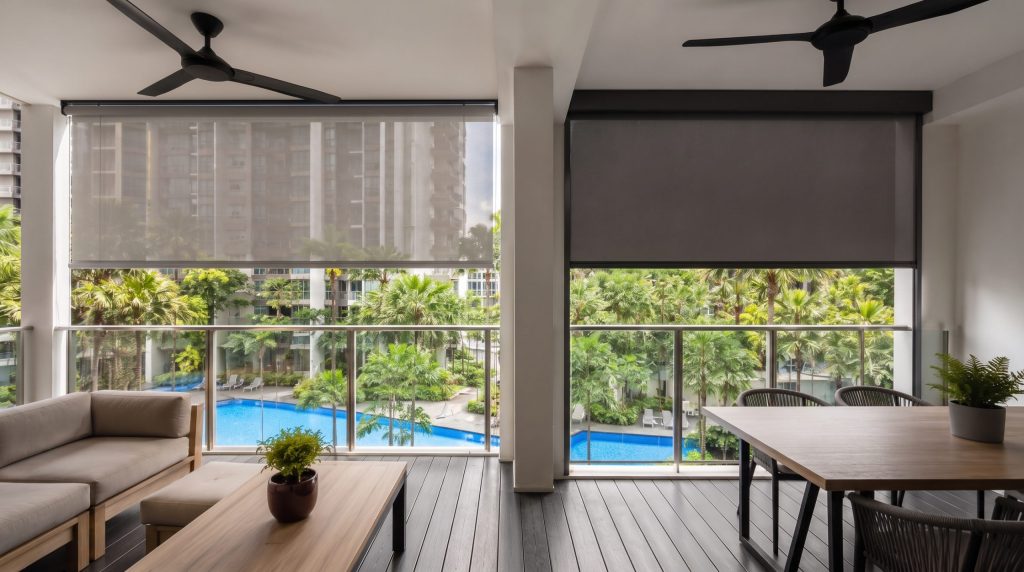
Outdoor blinds can help reduce rain splash, but standard cable-guided blinds are not a sealed wall. Small gaps remain at the sides, so wind-driven rain can still enter.
For very exposed balconies or severe weather, EcoHaus recommends raising standard outdoor blinds rather than leaving them down against extreme conditions.
ZipScreen provides greater enclosure because its fabric is retained inside side channels, but an outdoor fabric system should still not be confused with glazing or a permanent wall.
If keeping an area completely dry is the primary objective, tell the consultant that from the beginning. The recommendation may be different from a home where the main concern is simply afternoon glare.
Choosing the right outdoor blind fabric
Once the system is settled, fabric selection determines how the space actually feels.
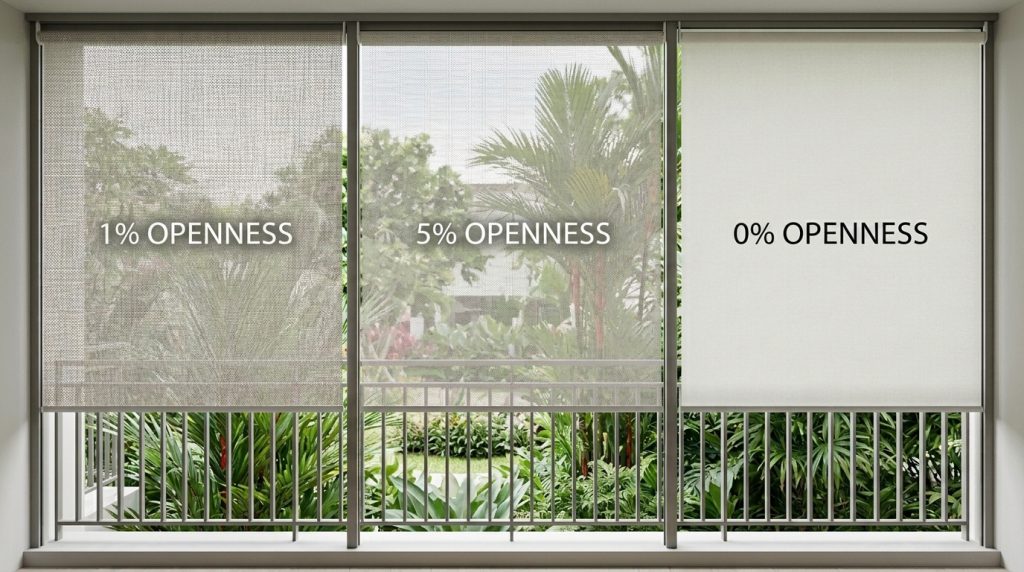
A more open mesh generally preserves more airflow, daylight and outward visibility. This works well when you enjoy your balcony view and mainly want to soften harsh sunlight.
A tighter weave provides greater coverage and privacy but reduces some of that openness.
There is always a trade-off.
Want to preserve your view?
Choose a screen fabric that allows greater outward visibility.
It can reduce uncomfortable direct light without making the balcony feel completely enclosed.
Want more daytime privacy?
A tighter screen can create a stronger visual boundary between your balcony and neighbouring units.
Remember that screen privacy changes with lighting conditions. A fabric that provides good privacy during a bright afternoon may behave differently at night when your balcony is illuminated and the surroundings are dark.
Dealing with intense afternoon sun?
Prioritise glare and solar protection rather than choosing fabric purely by colour.
BCA’s tropical design guidance notes that east- and west-facing façades experience significant solar exposure in Singapore, so the orientation of your balcony is worth considering when choosing the degree of coverage.
Manual or motorised outdoor blinds?
When comparing manual and motorised outdoor blinds Singapore homeowners should consider both the size of the opening and how often the blinds will be used.
EcoHaus’s manual outdoor blind system can be customised up to approximately 2.5 m wide × 3 m drop per panel, while its motorised configuration can accommodate up to approximately 3 m wide × 3.5 m drop per panel, subject to the actual site and installation requirements.
For wider balconies, EcoHaus can install several panels side by side.
A manual system may be perfectly practical for a smaller opening that is easy to reach.
Motorisation becomes more useful when you have:
- several outdoor blind panels;
- larger or heavier blinds;
- wide balcony openings;
- blinds that are adjusted frequently; or
- a preference for operating multiple blinds more conveniently.
The best question is not whether motorisation sounds luxurious. It is whether you will actually use the blinds more consistently because they are easier to operate.
What about condo approval?
If you live in a condominium, check with your MCST before installation. Singapore’s Building and Construction Authority (BCA) provides guidance for strata owners on renovation and building matters, while the requirements of individual developments can differ.
BCA advises strata owners that alterations to external building features and additions that may affect a building’s appearance can require MCST permission.
Different developments can have different renovation and façade requirements, so approval at one condominium does not automatically mean the same installation is permitted at another.
Planning this before fabrication avoids an unnecessary headache later.
Outdoor blinds for HDB, condo and landed homes
The right installation depends heavily on the property type. That is why outdoor blinds Singapore homeowners choose for a sheltered condo balcony may differ from those used for a landed patio or a more exposed opening. The product may be the same, but the installation conditions can be very different.
Condo balconies
Exposure is the big question.
A sheltered lower-floor balcony may only need straightforward cable-guided outdoor blinds, while an exposed high-floor unit may justify considering ZipScreen.
Building management requirements should also be checked before installation.
HDB outdoor areas and service yards
Where installation is suitable and permitted, outdoor shading can help manage sun and privacy around service yards and other exposed areas.
The available mounting points and surrounding structure need to be assessed rather than assuming every opening can use the same configuration.
Landed homes
Outdoor blinds work particularly well around covered patios, pergolas and outdoor dining spaces where homeowners want shade without permanently enclosing the area.
If the outdoor space also needs overhead weather protection, EcoHaus provides roofing solutions that can be planned together with appropriate outdoor shading.
Measure the actual space, not just the opening
Outdoor blind measurement involves more than width and height.
The installer needs to identify a secure mounting position and consider columns, railings, floor levels, doors and other obstructions around the opening.
For a wide balcony, panel positioning matters too. Poor panel planning can leave gaps or side guides directly in important sightlines.
EcoHaus custom-makes its window solutions for individual homes rather than treating every opening as an off-the-shelf size.
A site assessment therefore gives you something measurements sent over WhatsApp cannot: context.
It allows the team to see the actual sun exposure, mounting conditions, opening size and how you intend to use the balcony before recommending a system.
Can outdoor blinds work with invisible grilles?
Yes, but plan both systems together.
For homes where balcony safety is also a priority, Invisible Grille can be incorporated alongside appropriate window or outdoor shading systems.
The installation sequence and available clearance matter, particularly when tracks or fixing points share the same area.
If you are renovating the whole balcony, mention both requirements during the first site assessment instead of arranging them separately at the end.
How to maintain outdoor blinds
Outdoor blinds naturally collect more dust and grime than indoor blinds.
For EcoHaus outdoor blinds, routine cleaning can be kept relatively simple. Loose dirt can be removed gently, while the fabric and appropriate components can be cleaned using mild soap, water and a soft brush.
Avoid aggressive chemicals or abrasive scrubbing unless the specific fabric manufacturer recommends them.
The cable guides and moving components should also be kept clear of obstructions.
Most importantly, do not force the blind if it is not moving normally. Check whether an object is obstructing the bottom bar or mechanism first.
If the operation remains uneven or difficult, arrange an inspection rather than repeatedly forcing it.
Which outdoor blind should you choose?
For a sheltered balcony where your priorities are sun, glare, airflow and privacy, EcoHaus outdoor roller blinds offer the simpler solution.
For an exposed balcony where wind, rain splash, insects and side gaps are bigger concerns, ZipScreen provides a more enclosed side-retention system.
And if you are still deciding, you do not need to make the call from product photos alone.
EcoHaus has spent 14 years working with Singapore homes, with more than 10,000 HDB, condo and landed-home projects completed. Our approach is to look at the actual opening, understand what is making the space uncomfortable and recommend a system that fits the conditions rather than simply specifying the most expensive option.
Contact EcoHaus to arrange a free, no-obligation site measurement and compare the outdoor blind options for your balcony.
Frequently Asked Questions
Are outdoor blinds suitable for Singapore’s weather?
Manufacturers design outdoor blinds for external use, but the right system still depends on the installation’s exposure. A sheltered balcony and a high-floor opening affected by stronger wind should not automatically use the same solution.
Can outdoor blinds stop rain completely?
Standard cable-guided outdoor blinds can reduce rain splash but are not completely sealed because gaps remain along the sides. If stronger weather protection is important, consider a side-retained system such as ZipScreen.
Do outdoor blinds help with afternoon sun?
Yes. External shading can reduce direct solar exposure before it reaches the glazing or interior space. This is particularly relevant to east- and west-facing openings in Singapore.
Can I motorise outdoor blinds?
Yes. EcoHaus offers motorised outdoor blinds, subject to the dimensions and site conditions. Motorisation is particularly useful for wider openings and multiple-panel installations.
What is the maximum size of an EcoHaus outdoor blind?
EcoHaus currently states a maximum of approximately 2.5 m wide × 3 m drop per panel for its manual system and 3 m wide × 3.5 m drop per panel for its motorised system. Wider openings can be divided into multiple panels.
What warranty does EcoHaus provide for outdoor blinds?
EcoHaus currently provides a 1-year warranty for manual outdoor blind systems and a 3-year warranty for motorised systems, covering the relevant motor, internal hardware and moving mechanisms. Fabric is excluded from this stated coverage because it is subject to normal external exposure and wear.
Should I choose Outdoor Blinds or ZipScreen?
Choose standard outdoor blinds when the opening is relatively sheltered and your priorities are shade, privacy and affordability. Consider ZipScreen when stronger wind stability, reduced side gaps, rain-splash protection and insect reduction are more important.