Beating the Heat: How Much Can Honeycomb Blinds Really Lower Your Air-Con Bill in Singapore?
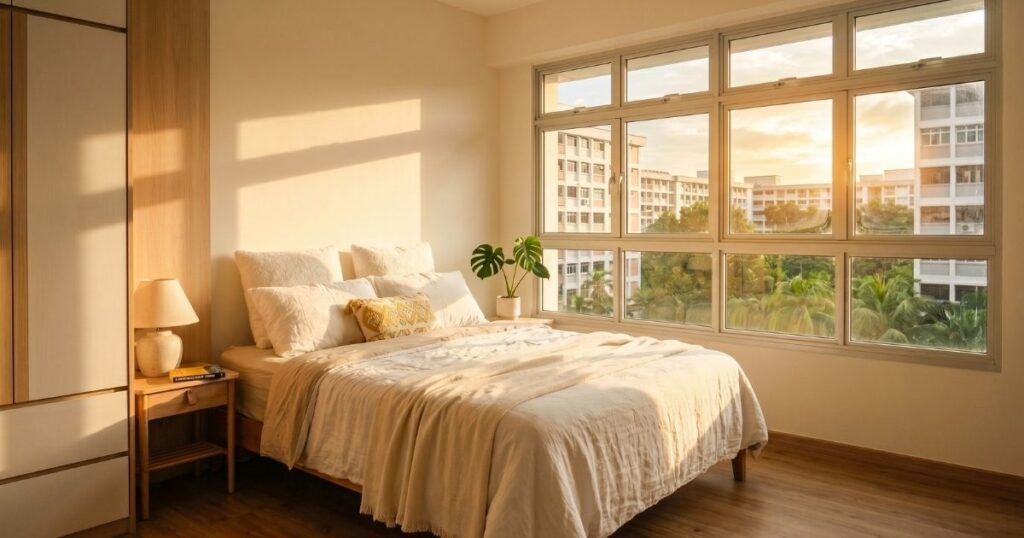
If you’ve ever walked into your bedroom at 4pm and felt like you’d stepped into an oven, you already know the problem. Singapore’s sun doesn’t ease in gently — it comes in hard and low through west-facing windows, heats up your glass, and by the time you switch on the air-con, your unit is already working overtime just to undo the damage.
So when a homeowner asks us, “will honeycomb blinds actually bring my electricity bill down, or is this just marketing?” — it’s a fair question. Here’s what the research actually shows, and what you can realistically expect in a Singapore home.
Why your windows are doing the most damage
Before getting into blinds, it helps to understand what’s actually happening. Windows are typically the weakest point in a home’s thermal envelope — single-pane glass conducts heat far more readily than your walls or roof, and unlike walls, glass also lets solar radiation pass straight through and heat up everything it touches. In a Singapore HDB or condo unit with large windows and little shade, that’s a lot of unmanaged heat gain, all day, every day.
This is where window coverings earn their keep. But not all coverings perform equally, and this is where honeycomb (also called cellular) blinds separate themselves from ordinary curtains or roller blinds.
What makes honeycomb blinds different
Cut a honeycomb blind in cross-section and you’ll see rows of hexagonal air pockets — hence the name. Each cell traps a layer of still air between your window and your room. Still, trapped air is a genuinely good insulator, and stacking these pockets creates a barrier that does two jobs at once: it slows heat transfer through the window, and it reduces the amount of solar heat that reaches your room in the first place.
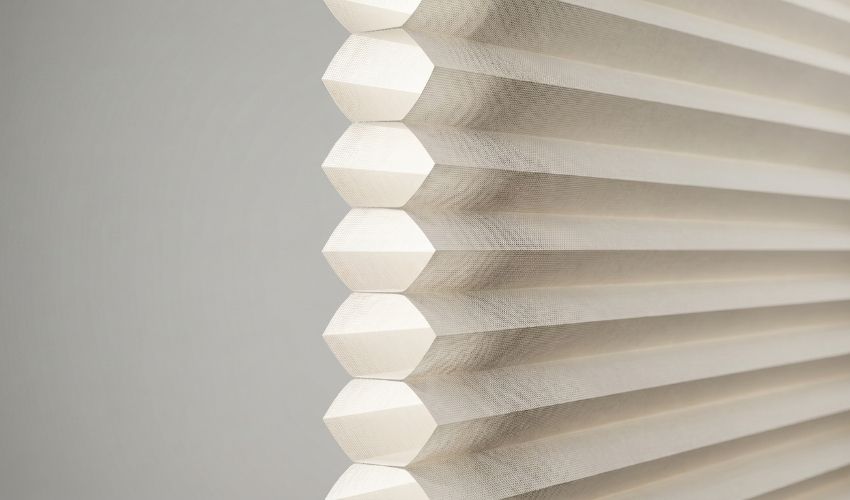
That’s structurally different from a curtain, which mostly just blocks light, or a standard roller blind, which has no insulating air layer at all. If you’d like to see the full range, browse our Honeycomb Blinds collection for fabric and colour options suited to different window orientations.
What the research actually says (and where it gets misapplied)
Here’s where we want to be upfront with you, because this is exactly where a lot of blind retailers get sloppy. You’ll see “15–25% savings” thrown around online with no source attached — and that number isn’t fabricated, but it’s also not the full picture.
The ORNL Study: What the Numbers Actually Show
The most credible data comes from Oak Ridge National Laboratory (ORNL), a US Department of Energy research lab. Their team tested cellular shades against generic venetian blinds in adjacent, near-identical rooms over two heating seasons. The room fitted with cellular shades achieved heating energy savings of up to 24%.
A related national-scale study, published in the peer-reviewed journal Energy and Buildings, compared cellular shades with no shading at all. Total site energy savings for heating and cooling ranged from roughly 9% (homes with heat pumps) to about 15% (homes with gas furnaces). Day-to-day experimental readings hit as high as 17–36% during the coldest periods.
Why Heating-Climate Data Doesn’t Translate Directly to Singapore
Notice the pattern: this research measures heating savings in temperate climates. Singapore doesn’t heat homes — we cool them, year-round, against direct tropical sun. These studies are solid science. But quoting a “24% savings” figure to a Singapore homeowner without that context is misleading.
What This Means for Your Air-Con Bill
The more relevant figure for us is solar heat gain reduction. This measures how much heat the blind stops from entering the room in the first place — the metric that actually drives your air-con load here. Testing on cellular shades shows they can cut unwanted solar heat gain by 60–80%, depending on cell construction, colour, and fit.
That’s a meaningful reduction in the heat your air-con has to fight. But it’s not a one-to-one translation into “your bill drops by X%.” Your actual savings depend on a few things: your unit’s orientation, how much of your wall is glass, any existing window film, and how consistently you close the blinds during peak sun hours.
Our honest estimate for a typical Singapore home: a well-fitted honeycomb blind on a sun-facing window can meaningfully reduce indoor heat load and take pressure off your air-con. Homeowners we’ve worked with commonly report cooler rooms and shorter cooling run-times. That said, we’d rather give you a realistic range once we’ve seen your actual window orientation and glass type than quote a number that isn’t yours.
Honeycomb blinds vs curtains: which actually blocks more heat?
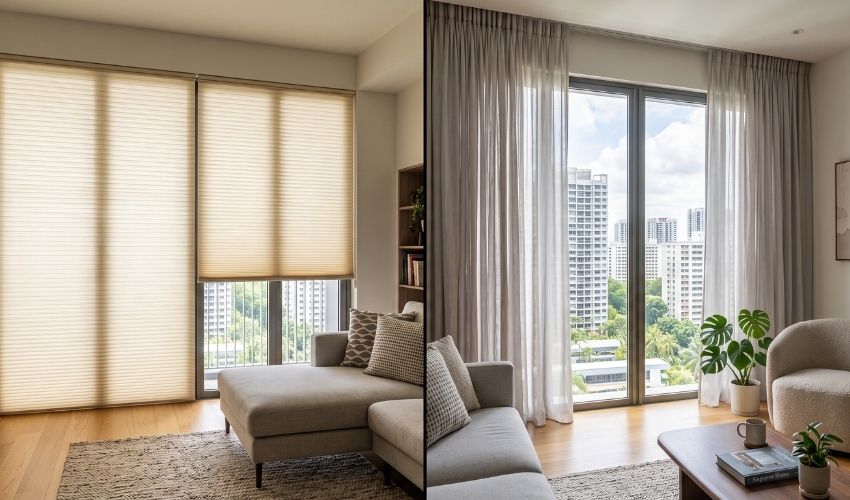
Curtains, especially blackout or thermal-lined ones, do help — they block direct light and add a fabric layer. But they typically hang loosely and don’t seal against the window frame, so hot air still circulates around the edges and behind the fabric. Honeycomb blinds, when properly sized, fit closer to the frame and trap that layer of insulating air right against the glass. For pure heat management in a tropical climate, honeycomb blinds generally outperform curtains — though curtains still win on softness and drape if that’s the look you’re going for. Many of our clients actually layer both: honeycomb blinds for heat and privacy control, with curtains for texture and evening ambience.
Day vs Blackout Honeycomb Blinds: Which One Should You Choose?
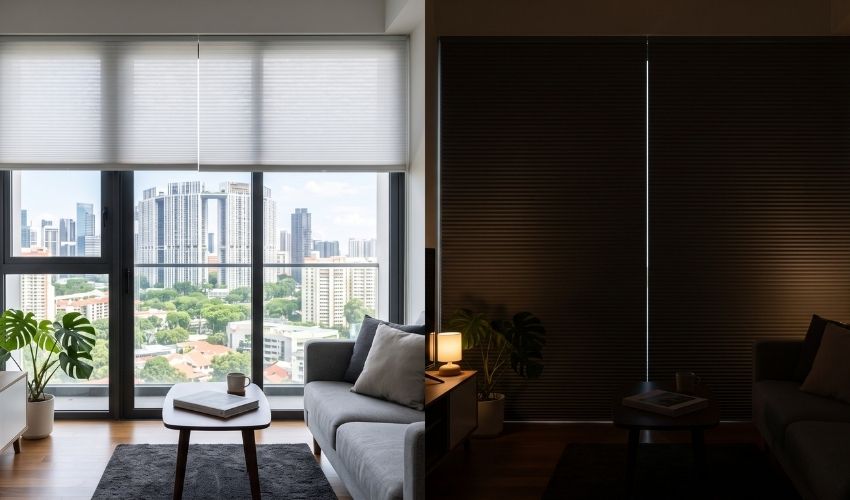
This is one of the most common questions we get, and the answer depends on how you actually use the room:
Day (Translucent) honeycomb blinds filter sunlight into a soft, even glow rather than blocking it outright. They’re the better fit for living rooms, studies, or any space where you still want daylight and a sense of the outdoors, just without the glare and raw heat hitting you directly.
Night (Blackout) honeycomb blinds are built with a foil-lined cell that blocks all incoming light and delivers the highest level of thermal insulation across the entire honeycomb range. If your priority is cutting heat and getting full darkness for sleep, this is the stronger performer — ideal for west-facing bedrooms or units that bake in the afternoon sun.
Can’t decide between the two? Our Day & Night system stacks both fabrics into a single blind, so you get filtered daylight through the day and switch to full blackout at night without changing blinds.
Not sure if single or double cell suits your unit? [Chat with our specialists on WhatsApp for a straight answer →]
Getting the most out of your honeycomb blinds
A few things matter more than people expect:
- Fit is everything. Gaps at the sides let hot air bypass the insulating layer entirely — this is why we take precise measurements rather than working off standard sizes.
- Close them before the heat builds, not after. Shutting blinds once a room is already hot only slows further gain; closing sun-facing blinds proactively during peak hours (roughly 11am–4pm for west-facing units) does far more work.
- Colour matters. Lighter, reflective fabrics on the outward-facing side bounce more solar radiation before it becomes heat inside the cell structure.
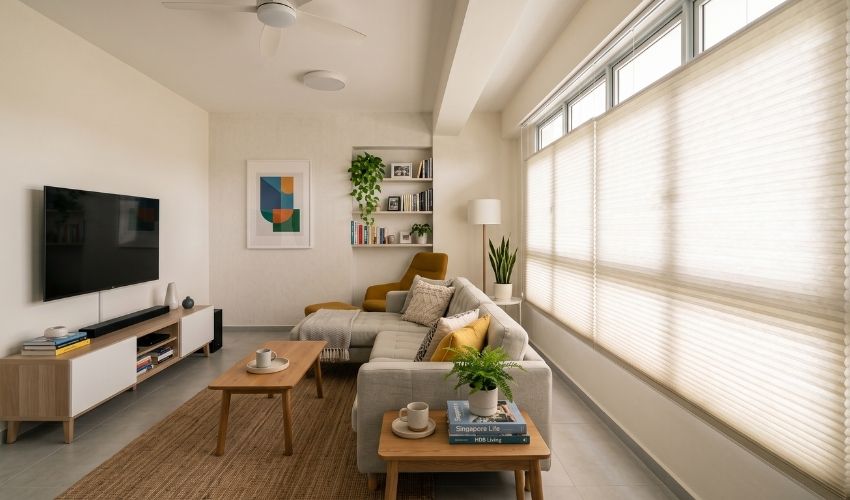
Honeycomb Blinds Singapore: The Bottom Line
Honeycomb blinds are one of the more genuinely effective window treatments for a hot climate — the underlying physics is sound, and the research backs the insulating effect, even if the headline percentages you’ll see quoted online were measured for winter heating in a different climate. What you can expect in your Singapore home is a real reduction in solar heat gain and a cooler room to begin with, which takes real pressure off your air-con. We’d rather walk you through what that looks like for your specific windows than hand you a number that was never about your home in the first place.
We’ve been fitting Singapore homes — HDB flats, condos, and landed properties — with window solutions built for our heat and humidity for 14 years, across more than 10,000 homes. If you’re weighing up honeycomb blinds against curtains or trying to decide between Day and Blackout for a specific room, we’re happy to take a look and give you a straightforward answer, not a sales pitch.
Ready to see what honeycomb blinds could do for your home? [Book your free home consultation →]