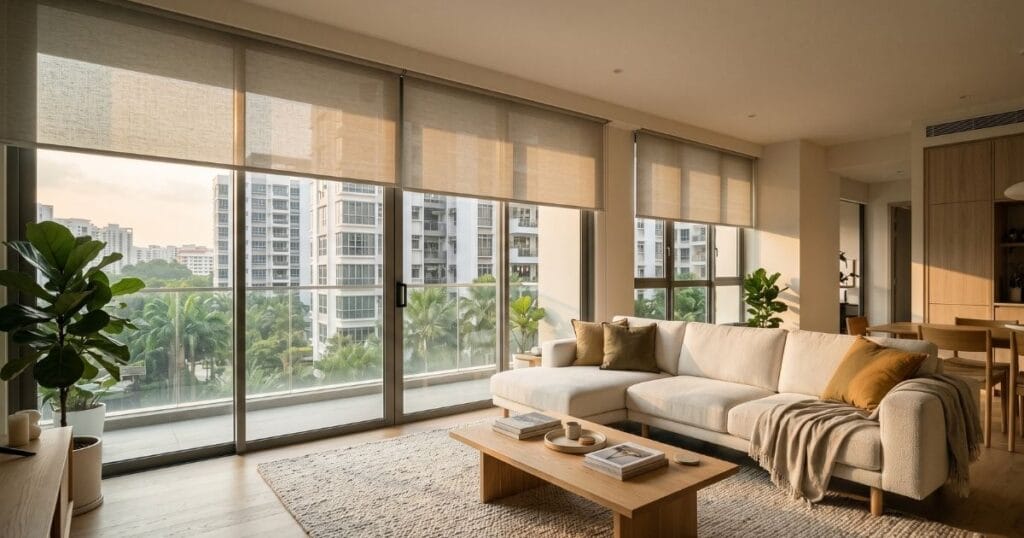
The afternoon sun can completely change how a room feels.
A bright living room at lunchtime can become hot and glaring by 4pm. The television reflects the sunlight, your home office screen becomes harder to see, and suddenly closing four or five blinds feels like another little job waiting to be done.
That is where motorised blinds in Singapore start to make sense.
They are not only for luxury homes or complicated smart-home setups. Motorisation can simply make everyday light and privacy easier to manage — whether that means lowering the blinds across a wide HDB living room, darkening a bedroom before bedtime, or controlling several blinds across a large condo or landed home.
But do you actually need motorised blinds?
Not necessarily.
The right answer depends on your windows, how often you adjust your blinds, the room itself and whether the convenience is worth the additional investment for your household.
How Motorised Blinds Can Make Daily Living Easier in Singapore
The main reason motorised blinds Singapore homeowners choose are useful is simple: you no longer need to operate every blind individually by hand. The biggest difference is simple: you no longer need to operate every blind individually by hand.
Depending on the motor and control system selected, blinds can be operated using a remote control, wall control or compatible smart-home setup. Multiple blinds may also be grouped together, depending on the configuration.
That becomes particularly useful when you have:
- Several blinds across one living room
- Wide or tall windows
- Hard-to-reach windows
- Large motorised blinds
- Outdoor blinds that are adjusted regularly
- A home where you prefer fewer visible operating cords or chains
Imagine a west-facing living room with four large windows.
Instead of walking across the room and lowering each blind separately when the afternoon sun arrives, motorisation allows the blinds to be controlled much more conveniently.
And in Singapore, controlling direct sunlight isn’t only about comfort. NEA recommends using curtains or blinds over windows during the hottest part of the day to help keep the home cooler.
The motor doesn’t make the fabric better at blocking heat — it simply makes it easier to actually use your blinds when you need them.
Where Do Motorised Blinds Make the Most Sense?
Motorisation isn’t automatically worthwhile for every window.
A small kitchen window that you adjust once every few days probably doesn’t need a motor. A row of large living-room windows that you operate twice a day is a very different story.
Here is how we would think about it room by room.
Living Room: Great for Multiple or Wide Windows
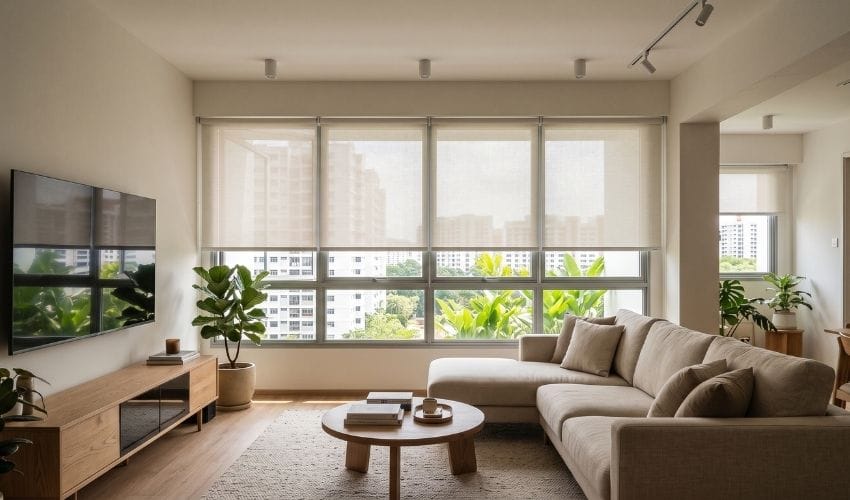
Living rooms are one of the places where motorised blinds Singapore homeowners install can make the biggest everyday difference, particularly across multiple or wide windows.
Singapore HDBs and condos often have several window panels across the living and dining area. If your home receives strong afternoon sunlight, being able to lower several blinds together can make daily light control much easier.
For a clean, minimal look, motorised roller blinds are a practical choice.
You can then choose the fabric according to what you actually want the room to do.
Sunscreen fabric is useful when you want to reduce glare while retaining daylight and some outside view.
Dimout fabric softens the light further and gives the room a more sheltered feel.
Blackout fabric is better when privacy and stronger light control are the priority.
Don’t choose the motor first.
Choose how you want the room to feel first — then choose the fabric and motor around it.
Bedroom: Motorisation Is About Routine
Bedrooms are another place where automatic blinds can be genuinely useful.
You may want your blinds closed before bedtime and opened again in the morning. If your selected control system supports scheduling, that routine can be automated.
But the motor itself does not create a blackout room.
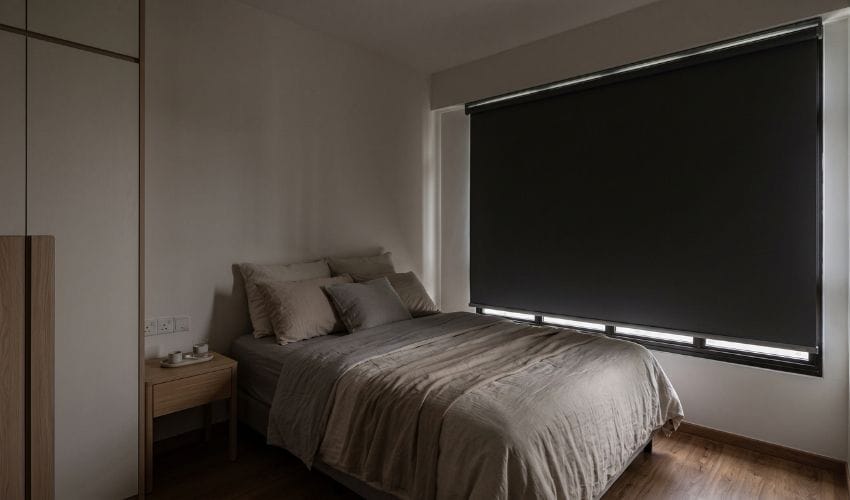
For bedrooms where darkness matters, blackout roller blinds are usually the more practical starting point.
The blackout fabric prevents light from passing directly through the material, but small amounts of light can still enter around the edges depending on the installation.
If you are a light sleeper, shift worker or designing a nursery, tell us that during the consultation rather than simply asking for “blackout blinds”. The fitting details matter just as much as the fabric.
Want More Flexible Light Control? Consider Korean or Venetian Blinds
Not every room needs to become dark.
Sometimes you simply want to soften the sunlight without losing the brightness that makes the room feel open.
Korean blinds use alternating sheer and solid fabric sections, allowing you to adjust the balance between daylight and privacy.
Venetian blinds work differently. Their horizontal slats can be tilted to redirect sunlight while keeping the room bright, and selected configurations can also be motorised.
These can be useful in living rooms, studies and spaces where controlling the direction of light matters more than simply opening or closing the entire window covering.
Large Sliding Doors: Don’t Forget Motorised Curtains
Motorisation doesn’t stop at roller blinds.
If you prefer a softer, more luxurious finish across a large living room or balcony door, motorised curtains may make more sense.
Ecohaus also offers Dream Curtains, which combine the soft appearance of curtains with individual overlapping panels. Motorised configurations are available for homeowners who prefer push-button or compatible app-based operation.
The important point is that “motorised” describes how the window furnishing moves — not what type of window furnishing you should choose.
Start with the right product for the room.
Then decide whether motorisation improves the way you will use it.
What About Motorised Blinds for Balconies?
This is where the decision becomes more technical.
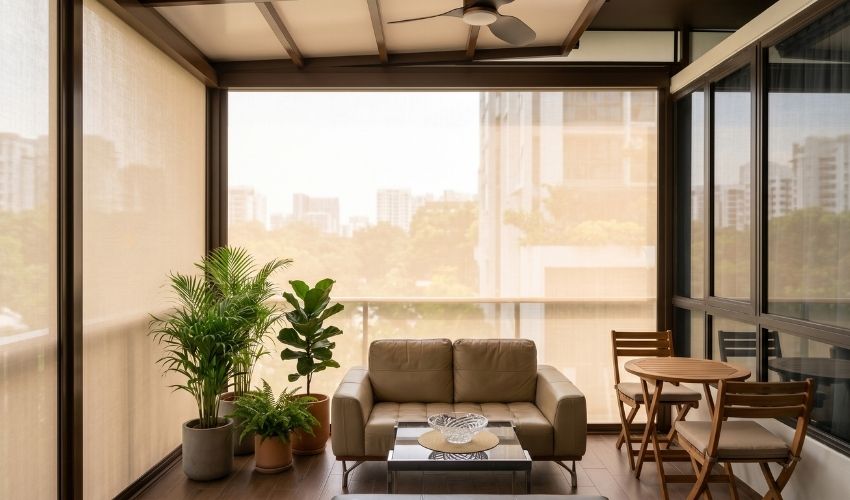
Singapore balconies have to deal with much more than indoor sunlight. There is heat, glare, humidity, wind and wind-driven rain to consider.
For a relatively sheltered space where your main priorities are shade and privacy, outdoor roller blinds may be sufficient. Motorised versions are available and can be especially useful for larger or frequently operated panels.
For more exposed balconies, ZipScreen provides a different system altogether.
Instead of cable guides, ZipScreen retains the fabric within aluminium side channels. This provides greater stability and reduces the open side gaps found on conventional outdoor roller blinds.
Motorised ZipScreen can be particularly useful for:
- High-floor condo balconies
- Wide balcony openings
- West-facing outdoor spaces
- Multiple panels
- Frequently used outdoor areas
- Landed-home patios
But outdoor blinds should not be chosen from a photograph alone.
Wind exposure, opening dimensions, fixing surfaces, electrical preparation and the surrounding structure all matter. A proper site assessment helps determine whether a standard outdoor blind or ZipScreen is the more suitable solution.
Battery or Wired Motor: Which Is Better?
When planning motorised blinds in Singapore, the power arrangement is worth discussing before renovation work is completed. This is one of the most useful questions to answer before renovation work is finished.
There isn’t one power arrangement that is right for every home.
Battery-Powered Motors
A battery-powered setup can be useful when electrical wiring is difficult or when the home is already completed.
The main advantage is simpler electrical preparation around the window.
The trade-off is straightforward too: the battery eventually needs charging.
That may be perfectly manageable for an accessible bedroom window. It becomes less convenient when the blind is several metres above the floor.
Wired Motors
If you are renovating, it is worth discussing motorised blinds early with your electrician and interior designer.
A properly planned power point can give you a cleaner installation and removes the need to periodically recharge a battery.
This becomes particularly useful for large blinds, high windows, multiple motorised panels and outdoor systems that are operated frequently.
The important part is planning.
Don’t finish the carpentry, ceiling and electrical work first and only then decide you want motorised blinds.
For example, Ecohaus’ current roller-blind system cannot simply convert an existing manual blind into a motorised one later because the internal mechanism is different.
If motorisation is even a possibility, tell your blinds specialist and renovation team early.
Do You Need Smart-Home Integration?
Not always.
For many households, a remote control does everything they actually need.
Press a button. Blinds go down.
Done.
Smart-home integration becomes more useful when you want scheduled routines or compatible app-based control.
For example, you might want selected blinds lowered before the strongest afternoon sunlight reaches your living room.
But there is little benefit in paying for a complicated setup that nobody in the household wants to use.
Think about the person who will operate the blinds most often.
If your parents prefer a physical remote, keep it simple.
If your household already uses smart-home automation every day, integration may make much more sense.
The best control system isn’t necessarily the smartest one. It is the one everyone at home will actually use.
Can Motorised Blinds Help Keep Singapore Homes Cooler?
Motorised blinds Singapore homes use for afternoon sun control can make it easier to lower the blinds consistently during hotter parts of the day. The motor itself, however, does not reduce heat — the shading system and fabric do the actual work. The blind can. The motor simply makes using it easier.
That distinction matters.
Singapore’s National Environment Agency recommends using curtains or blinds over windows to block unwanted solar heat, particularly during the hottest parts of the day.
Your actual heat reduction will depend on factors including:
- Window direction
- Time of day
- Glass type
- Fabric colour and construction
- Fabric openness
- How much of the window is covered
- Whether the shading is installed indoors or outdoors
This is why two homes using the same motor may have completely different results.
A west-facing condo living room in Clementi and a north-facing HDB bedroom in Punggol do not have the same sunlight problem.
The motor provides convenience.
The fabric and system provide the shading.
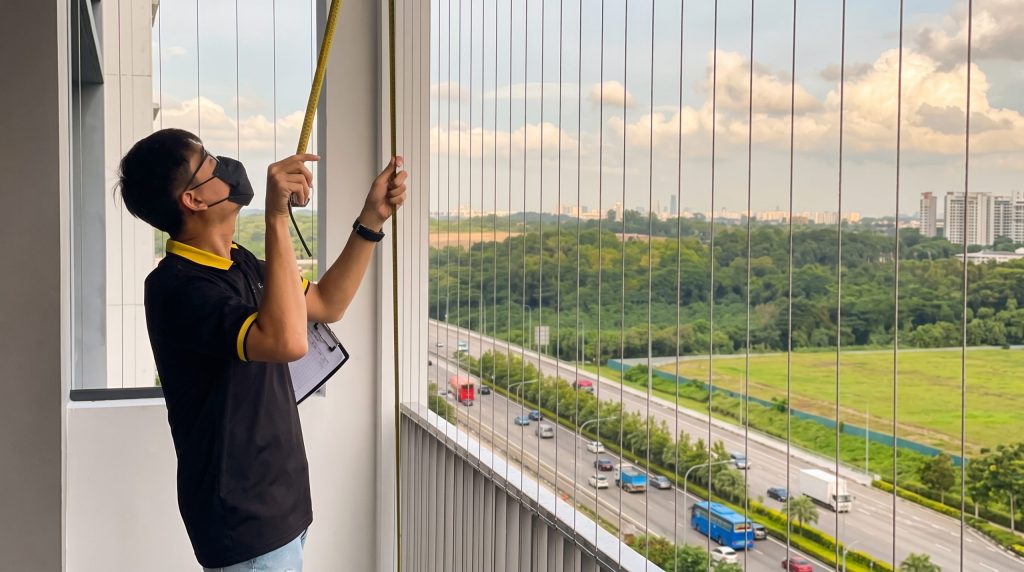
Measure First. Motorise Second.
A good motor cannot rescue a badly fitted blind.
Width, height, mounting position, window handles, ceiling details and surrounding furniture all affect the finished installation.
The larger the blind becomes, the more important these details are.
That is why Ecohaus window furnishings are custom-made rather than treated as one-size-fits-all products.
During an on-site assessment, we can look at more than just measurements. We can consider where the sunlight enters, how you use the room, what level of privacy you need, where electrical points are located and whether motorisation genuinely makes sense for that particular window.
Sometimes it does.
Sometimes a manual blind is all you need.
We would rather help you choose the right setup for the room than add technology simply because it is available.
What Maintenance Do Motorised Blinds Need?
Motorised blinds are generally straightforward to live with, but they are still fitted mechanical systems.
For indoor fabric blinds, regular light dusting with a soft cloth, feather duster or low-suction vacuum attachment is usually enough, depending on the fabric.
Keep furniture and decorative items away from the blind’s travel path.
And most importantly, don’t manually pull or force a motorised blind when something isn’t moving correctly.
If a blind starts travelling unevenly, rubbing against something or stops responding, stop operating it and arrange for it to be checked.
For outdoor systems, periodically keeping tracks and surrounding areas free from loose dirt and debris can also help the system operate smoothly.
So, Are Motorised Blinds Worth It in Singapore?
Whether motorised blinds Singapore homeowners choose are worth the investment really depends on the window and how often the blind is used.
For others, probably not.
Motorisation tends to offer the most value when you have:
- Multiple blinds that you operate together
- Large or tall windows
- Hard-to-reach windows
- Wide living-room openings
- Frequently adjusted blinds
- Motorised outdoor blinds or ZipScreen
- A household that values scheduled or convenient control
A manual blind can still be the smarter choice for a small, easily accessible window that you rarely adjust.
The goal isn’t to motorise everything.
It is to make the parts of your home you use every day easier to live with.
Ecohaus has spent 14 years working with window furnishings across more than 10,000 Singapore homes, from HDB flats and condos to landed properties.
Our approach is simple: understand the room first, then recommend the window solution that fits your space, lifestyle and budget.
Not sure whether your windows actually need motorisation?
Book a free, no-obligation on-site measurement with Ecohaus and we can look at the window size, sunlight, fabric, power arrangement and control options with you before you decide.